
Finite Element Analysis for Design & Assessment
Advanced simulation developed around a defined engineering question, appropriate assumptions, verification checks and applicable acceptance criteria.

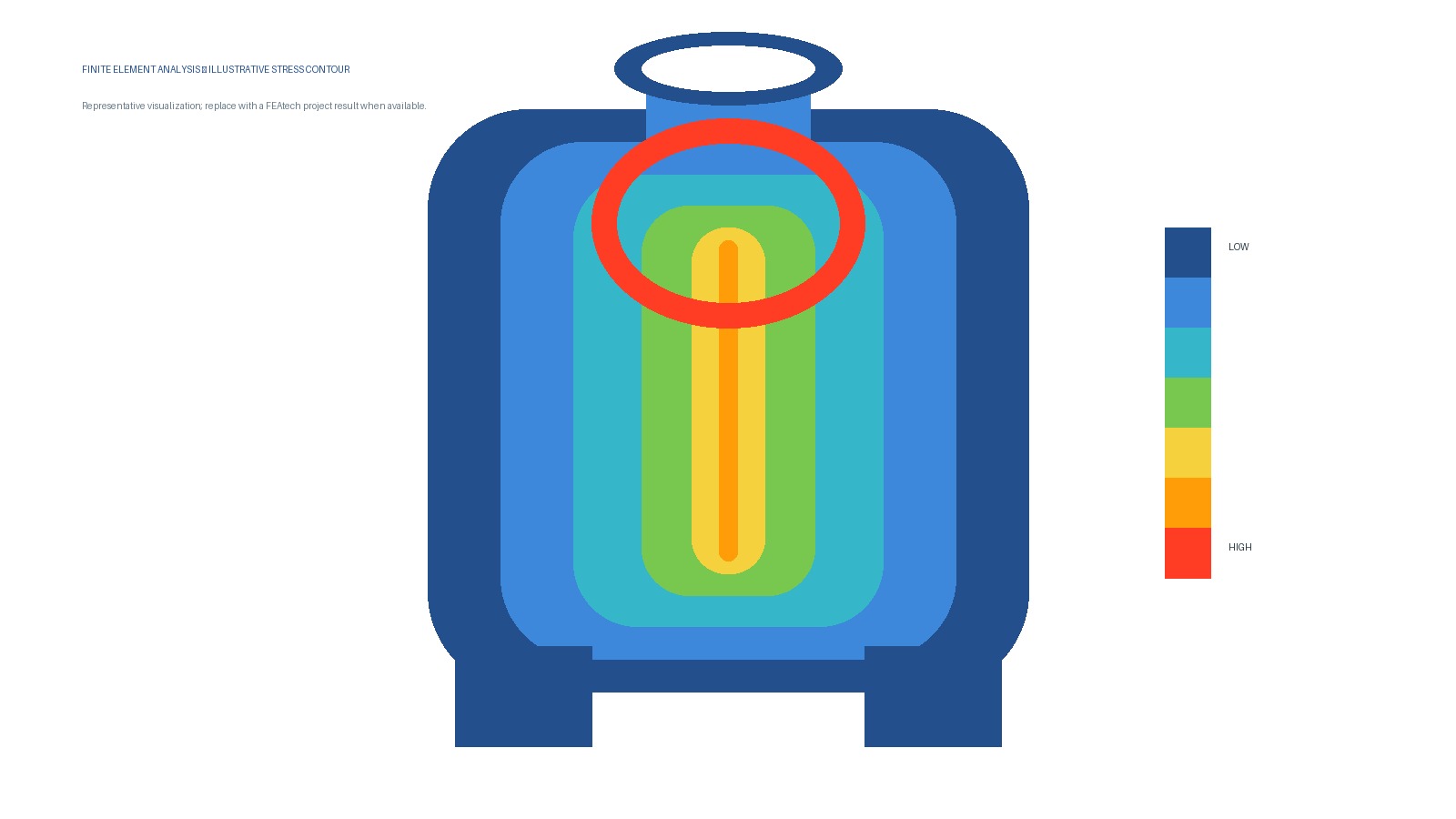
FEA is an engineering tool
The purpose of analysis is not a colourful contour plot. It is to understand behaviour and make a defensible engineering decision.
Applications
- Structural stress and deformation
- Mechanical equipment and components
- Pressure vessels, nozzles and attachments
- Contact and nonlinear response
- Thermal and thermal-stress analysis
- Natural frequencies, modes and forced response
Workflow
DEFINE → MODEL → VERIFY → ANALYZE → INTERPRET → ENGINEER
Analysis developed around the decision
A useful FEA model starts with the engineering question—not the mesh. Geometry idealization, element selection, material behaviour, contacts, restraints and loads are selected to represent the physical system at the level of fidelity required for the decision. Results are then checked against equilibrium, expected behaviour and independent calculations where practical.
From results to engineering action
FEAtech interprets stresses, deformation, temperature fields, modes and dynamic response in the context of applicable criteria. The objective is to identify the governing behaviour, explain its significance and develop a practical design, modification or assessment—not simply deliver contour plots.
From simulation results to engineering decisions
Finite element analysis is most useful when the model is built around a specific design or assessment decision. Geometry, material properties, loads, boundary conditions and model simplifications all affect the results. FEAtech connects the analysis findings to the engineering question, explaining relevant stresses, deformation and assumptions rather than relying on contour plots alone.